Friday, 27 April 2012
800 VIEWS!!!
Labels:
800 views,
Animals,
blog,
celebration,
support
Location:
Irlandia
Animal cruelty presentation
In school we learned how to use an internet program called Prezi.
Then we had to make a presentation with it. I decided to use this opportunity well and my presentation is about animal cruelty.
Here it is:
Labels:
animal cruelty,
Animals,
circuses,
furs,
marine parks,
peta.org,
presentation,
school,
testing on animals
Location:
Irlandia
Sunday, 4 March 2012
Do something good this Lent ?
It's oficially Lent. I tought that this Lent we should all do something good. Here are some ideas:
- Donate money to charity
- Recycle
- Help out in your local dog shelter
- Plant a tree
- Give up animal tested products
- And anything else that there is to do to help animals and the enviroment.
Labels:
Animals,
charity,
dog shelter,
easter,
enviroment,
lent,
plant trees,
recycling
Location:
Irlandia
Sunday, 13 November 2011
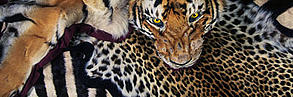
Tigers, trade
A century ago there were 100,000 tigers roaming the forests,
swamps, and tundra of Asia. TODAY, there are as few as 3,200 left in the
wild. Only 7% of historic tiger habitat still contains tigers.
At this rate, wild tigers will be extinct in just a few decades.
Consumer demand for tiger parts poses the largest threat to tiger survival. Tigers are being hunted to extinction by poachers for their skins, bones, teeth and claws, which are highly valued for their use in traditional Asian medicine (TAM), various folk remedies and various products. The wildlife trade network, TRAFFIC, found that for the past two years, the smuggled parts from at least 200 tigers have been confiscated per year by law enforcement in Asia. In the past 10 years, over 1000 tigers have been killed to traffic their parts to meet consumer demand in Asia.
Tiger bones have been used in TAM for a wide variety of ailments for
more than 1,000 years. In 1993 the Chinese government banned the trade
and use of tiger parts, but cultural belief in the power of tiger parts
remains.
Parts from a single tiger can fetch as much as $50,000 on the black
market, making the poaching of these magnificent creatures very alluring
to criminal networks.
Claws, teeth and whiskers are believed to prov ide good luck and
protective powers. And tiger skins and tiger bone wine are valued as
status symbols.
Links:
Saturday, 12 November 2011
Blog,Project and Trade
I'm back!!! It's me Marta, remember? You might not (hopefully you do) because I have not been posting :( .
Miss me?!(I missed posting). I didn't post because (drumroll) I had internet limit. Now back to the title:
1.Blog: I have a new blog called " My fun and wonderful life
( Read it to find out that it is funny but not that woderful).
2.Project: My school is doin a project about homelessness and poverty. I will be talking about it and giving news on it on my other blog (remember, the one on top in 1 ). Now back to animals so my partner in crime Rachie does not get angry.
Bloody, Cruel Trade
I want to discuss this topic in a few posts, so it's what your gonna read much of now.
Every day I will do a diffrent topic but for now you need to know how bad it is.
Manny animals are killed for their furs, bones, skins, teeth and meat.
lthough most wildlife trade is legal, a significant amount is not. For example, in just one year during 2003-04, EU-based enforcement authorities made more than 7,000 seizures – these included more than 3.5 million wildlife specimens that were prohibited from being traded. And from 2002-06, almost 1,000 illegally-traded Egyptian tortoises were seized in the EU, which represent around 13% of the species’ entire wild population – an illustration of how devastating trade impacts can be. From WWF ( At bottom of blog)
YOUR MARTA
Miss me?!(I missed posting). I didn't post because (drumroll) I had internet limit. Now back to the title:
1.Blog: I have a new blog called " My fun and wonderful life
( Read it to find out that it is funny but not that woderful).
2.Project: My school is doin a project about homelessness and poverty. I will be talking about it and giving news on it on my other blog (remember, the one on top in 1 ). Now back to animals so my partner in crime Rachie does not get angry.
Bloody, Cruel Trade
I want to discuss this topic in a few posts, so it's what your gonna read much of now.
Every day I will do a diffrent topic but for now you need to know how bad it is.
Manny animals are killed for their furs, bones, skins, teeth and meat.
lthough most wildlife trade is legal, a significant amount is not. For example, in just one year during 2003-04, EU-based enforcement authorities made more than 7,000 seizures – these included more than 3.5 million wildlife specimens that were prohibited from being traded. And from 2002-06, almost 1,000 illegally-traded Egyptian tortoises were seized in the EU, which represent around 13% of the species’ entire wild population – an illustration of how devastating trade impacts can be. From WWF ( At bottom of blog)
YOUR MARTA
Labels:
Animals,
blog,
bloody trade,
bones,
cruelty,
furs,
homelessness,
internet,
school,
teeth,
wildlife,
WWF
Monday, 31 October 2011
Lab Animals
Long time no type!
Hey everyone :-)
Rachel is back in the house. Sorry I haven't posted in a while : exams : homework and loads more excuses :O But today I wanted to talk about Laboratory Animals.
Animal testing, also known as animal experimentation, animal research, and in vivo testing, is the use of non-human animals in experiments. Worldwide it is estimated that the number of vertebrate animals—from zebrafish to non-human primates—ranges from the tens of millions to more than 100 million used annually. Invertebrates, mice, rats, birds, fish, frogs, and animals not yet weaned are not included in the figures; one estimate of mice and rats used in the United States alone in 2001 was 80 million.Most animals are euthanized after being used in an experiment. Sources of laboratory animals vary between countries and species; most animals are purpose-bred, while others are caught in the wild or supplied by dealers who obtain them from auctions and pounds.
History.
As the experimentation on animals increased, especially the practice of vivisection, so did criticism and controversy. In 1655, the advocate of Galenic physiology Edmund O'Meara said that "the miserable torture of vivisection places the body in an unnatural state."O'Meara and others argued that animal physiology could be affected by pain during vivisection, rendering results unreliable. There were also objections on an ethical basis, contending that the benefit to humans di not justify the harm to animals. Early objections to animal testing also came from another angle — many people believed that animals were inferior to humans and so different that results from animals could not be applied to humans.
On the other side of the debate, those in favor of animal testing held that experiments on animals were necessary to advance medical and biological knowledge. Claude Bernard, known as the "prince of vivisectors" and the father of physiology—whose wife, Marie Françoise Martin, founded the first anti-vivisection society in France in 1883—famously wrote in 1865 that "the science of life is a superb and dazzlingly lighted hall which may be reached only by passing through a long and ghastly kitchen". Arguing that "experiments on animals ... are entirely conclusive for the toxicology and hygiene of man...the effects of these substances are the same on man as on animals, save for differences in degree," Bernard established animal experimentation as part of the standard scientific method.
This is Claude Bernard -
Numbers
Accurate global figures for animal testing are difficult to obtain. The British Union for the Abolition of Vivisection (BUAV) estimates that 100 million vertebrates are experimented on around the world every year, 10–11 million of them in the European Union. The Nuffield Council on Bioethics reports that global annual estimates range from 50 to 100 million animals. None of the figures include invertebrates such as shrimp and fruit flies. Animals bred for research then killed as surplus, animals used for breeding purposes, and animals not yet weaned are also not included in the figures.
Housing
Thanks everyone for listening :-)
The more people aware the less the probelm.
Rachel♥
Hey everyone :-)
Rachel is back in the house. Sorry I haven't posted in a while : exams : homework and loads more excuses :O But today I wanted to talk about Laboratory Animals.
Animal testing, also known as animal experimentation, animal research, and in vivo testing, is the use of non-human animals in experiments. Worldwide it is estimated that the number of vertebrate animals—from zebrafish to non-human primates—ranges from the tens of millions to more than 100 million used annually. Invertebrates, mice, rats, birds, fish, frogs, and animals not yet weaned are not included in the figures; one estimate of mice and rats used in the United States alone in 2001 was 80 million.Most animals are euthanized after being used in an experiment. Sources of laboratory animals vary between countries and species; most animals are purpose-bred, while others are caught in the wild or supplied by dealers who obtain them from auctions and pounds.
History.
As the experimentation on animals increased, especially the practice of vivisection, so did criticism and controversy. In 1655, the advocate of Galenic physiology Edmund O'Meara said that "the miserable torture of vivisection places the body in an unnatural state."O'Meara and others argued that animal physiology could be affected by pain during vivisection, rendering results unreliable. There were also objections on an ethical basis, contending that the benefit to humans di not justify the harm to animals. Early objections to animal testing also came from another angle — many people believed that animals were inferior to humans and so different that results from animals could not be applied to humans.
On the other side of the debate, those in favor of animal testing held that experiments on animals were necessary to advance medical and biological knowledge. Claude Bernard, known as the "prince of vivisectors" and the father of physiology—whose wife, Marie Françoise Martin, founded the first anti-vivisection society in France in 1883—famously wrote in 1865 that "the science of life is a superb and dazzlingly lighted hall which may be reached only by passing through a long and ghastly kitchen". Arguing that "experiments on animals ... are entirely conclusive for the toxicology and hygiene of man...the effects of these substances are the same on man as on animals, save for differences in degree," Bernard established animal experimentation as part of the standard scientific method.
This is Claude Bernard -
Numbers
Accurate global figures for animal testing are difficult to obtain. The British Union for the Abolition of Vivisection (BUAV) estimates that 100 million vertebrates are experimented on around the world every year, 10–11 million of them in the European Union. The Nuffield Council on Bioethics reports that global annual estimates range from 50 to 100 million animals. None of the figures include invertebrates such as shrimp and fruit flies. Animals bred for research then killed as surplus, animals used for breeding purposes, and animals not yet weaned are also not included in the figures.
Housing
What it does to animals -
Thanks everyone for listening :-)
The more people aware the less the probelm.
Rachel♥
Labels:
110 conibear,
300,
500 views,
Adele,
beckcam,
beckham,
belt,
Books,
Brad Pit,
car,
celebrieties,
Children,
contest,
Endangered Species,
fireworks,
juicystar07,
teen,
zoo
Thursday, 27 October 2011
Halloween safety
I guess loads of my readers have pets and I would like the pets to have as good of a halloween as you.
Safety tips
- No tricks, no treats: That bowl of candy is for trick-or-treaters, not for Scruffy and Fluffy. Chocolate in all forms—especially dark or baking chocolate—can be very dangerous for dogs and cats.
- Wires and cords from electric lights and other decorations should be kept out of reach of your pets.
- A carved pumpkin certainly is festive, but do exercise caution if you choose to add a candle. Pets can easily knock a lit pumpkin over and cause a fire. Curious kittens especially run the risk of getting burned or singed by candle flames.
- Dress-up can be a big mess-up for some pets. Please don't put your dog or cat in a costume UNLESS you know he or she loves it (yup, a few pets are real hams!). For pets who prefer their “birthday suits,” however, wearing a costume may cause undue stress.
- All but the most social dogs and cats should be kept in a separate room away from the front door during peak trick-or-treating hours. Too many strangers can be scary and stressful for pets.
- If you work in a pet store, remember that this is the time of year that can be deadly for black cats. Some sick people who play at being what they'll call a Satanist will buy them to "sacrifice" If you can, don't take any black cats or sell them during October. Many pet stores won't take them anyway, just for this reason.
- DON'T keep pets outdoors during Halloween and ensure that they have a safe, quiet place inside where they aren't frightened by all of the noise and excitement and where they cannot escape through the constantly open door. A quiet, inner room where they can't hear much of the noise from fireworks and loud bangs can help. Putting a radio or television on in the room can also be effective.
- DO make sure that rabbits and other caged animals are safely secured in a garage or outbuilding, away from the sight and sound of fireworks.
Location:
R393, Co. West Meath, Ireland
Subscribe to:
Posts (Atom)